



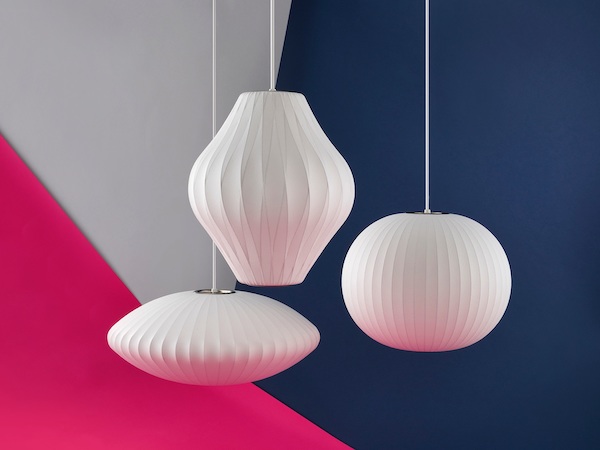
Developed in the 1950s, this series of pieces designed by George Nelson had a curious inspiration and a creative solution

Adapted text – Herman Miller
Developed in the 1950s, the iconic Nelson Bubble lamps possess a delicate, floating quality, whether hanging from the ceiling, mounted on the wall, or placed on a table or the floor.
Designed by George Nelson, the artist was inspired by a set of Swedish pendant lamps covered in silk, which he wanted to purchase for his office but found the price prohibitive.
As a creative and resourceful designer, he dedicated himself to finding a way to create his own series of lamps more efficiently. The curious fact lies in where Nelson found the solution: in a technique developed by the US military at the time.
With minor updates to the materials to increase durability, the same method is used to this day to produce the Nelson Bubbles – which in Brazil are distributed by Novo Ambiente, in São Paulo and Rio de Janeiro.
Curious to know the details of the story behind this classic and timeless collection? Check out how George Nelson’s creative process unfolded to create these pieces:
 A curious and creative story
As an influential mid-century modernist designer in the United States, George Nelson came across a set of pendant lamps from Sweden and loved their entire modern aesthetic, with the exception of the extravagant cost.
“The Swedish design featured a silk covering that was very difficult to make; they had to cut channels and sew them onto a wire frame. But I wanted one so badly,” Nelson wrote in his book, On Design, published in 1979.
While searching for alternatives to develop this piece, a seemingly unrelated reference soon led him to an intuitive idea. He recalled in his writings:
“It was a photo in the New York Times a few weeks before showing Liberty ships being mothballed by covering the decks with a net and then spraying it with a self-webbing plastic.”
Nelson located the manufacturer of this resinous plastic used by the military and utilized it in the manufacturing of the balloon-shaped lamps.

The first prototype of the lamp was designed in a matter of two days. The designer created the spherical frame using perforated rings inserted with steel wires—a structure that maintained its shape under tension, required minimal tooling, and had no welding costs.
It was then sprayed with the resinous lacquer to form a fibrous web, and a final layer of plastic was applied to create a smooth, translucent skin.
And so, Nelson had added lighting fixtures to his growing portfolio, presenting a beautiful and timeless lamp to his consumers at reasonable prices.
Nearly 70 years later, Herman Miller found three more designs in the George Nelson Foundation archives that had never been put into production by the brand.

“Design is a response to social change.” – George Nelson
Were you already familiar with the Nelson Bubble lamp series? Comment here on what you thought of this story and which model is your favorite. Take the opportunity to check out other articles like this on our blog!