




Ray Wilkes
When Ray Wilkes arrived in New York in the early 1960s with a Royal College of Art scholarship to study in the United States, he went straight to an office on 50th Street. Through his RCA connections, he was referred to George Nelson, the renowned architect, designer, and editor.
But first, Wilkes had to get past Hilda Longinotti, Nelson’s longtime assistant. “I walked in and said I wanted to meet George Nelson and she said, ‘That won’t be possible! Get out of here!’ It turns out that before I came in, they had had a big argument,” Wilkes recalls, so Longinotti was not in the mood to help.
Once Wilkes was initiated into Nelson’s world, he quickly made an impact. “Always sharp and very witty,” says Lance Wyman, a colleague from the Nelson Office days, describing Wilkes. One of Wilkes’s first projects involved solving design issues with the Sling Sofa produced by Herman Miller, part of the Museum of Modern Art’s permanent collection. “They were having problems where the upholstery connects to the frame,” he says. “I did some research: there was an English company that made rubber coatings, so I fastened that material [under the cushions] instead of weaving it.”
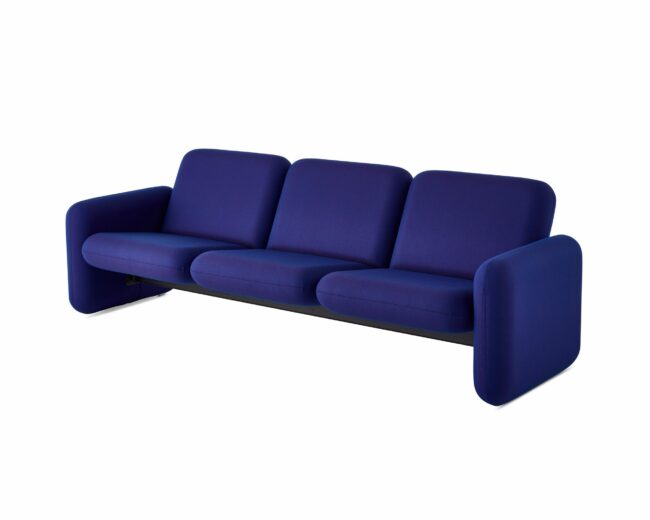
A decade later, Wilkes ended up in Michigan, working full-time for Bob Blaich, then Herman Miller’s director of design, who had recognized Wilkes from his time with Nelson. He designed his Modular Sofa Group (1976) while experimenting with a new foam-injection technology that created soft, defined forms that could be upholstered with Herman Miller’s two-way stretch fabrics.
As with the Eames and their molded plywood, the technology was a major ally in the final design outcome. When upholstered in vivid colors (a color palette designed by Alexander Girard), the square cushions with rounded edges look like chewing gum, which earned the sofa its nickname. The iconic postmodern design became highly prized in the vintage market over the decades since its introduction—and, with its reissue in 2021, gained new followers among design enthusiasts.
While at Herman Miller, Wilkes also designed a coffee table to complement the modular sofa collection, Soft Seating (1974), and the height-adjustable Rollback Chair (1977), whose profile was featured by The New York Times in its NeoCon coverage that year.
Since leaving Herman Miller, he has worked as a design consultant for companies in England, Europe, and the U.S.
Wilkes was born in Surrey, England, and graduated in design from London’s Royal College of Art.
See all