




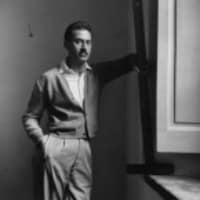
Franco Albini
Franco Albini studied architecture at the Polytechnic University of Milan, where he earned his degree in 1929. While still a student, Albini assisted Gio Ponti in his studio. Ponti’s influence is evident in Franco Albini’s early Art Deco designs.
In 1930, Franco Albini opened his own studio for design and interior decoration. After the war, Franco Albini also worked as an architect. In 1930, Franco Albini took part in the Monza Triennale, where he showcased his furniture designs. At the 1936 Milan Triennale, Franco Albini presented progressive designs for a rational layout of small rooms, called “estrofe per un uomo” (room for one man).
Albini designed a small room in which each element performs one or more functions: a table is integrated into a shelving system; the ladder leading to the loft bed also serves as a clothes rack; and the bed itself is a room divider. In 1941, Franco Albini designed a transparent radio (however, it was never produced).
Franco Albini’s most popular designs were created in the 1950s. The best known were his shelving and chair designs, produced by Cassina and especially by Poggi. The shelves are easy to disassemble and can be expanded without restrictions. They have no back panel, as they are braced between floor and ceiling or suspended from the ceiling by metal chains. This construction works as a transparent room divider. In 1951, Franco Albini created his wicker chair “Margherita”.
Since 1952, designer and architect Franca Helg was Franco Albini’s business partner; she played a crucial role in several Albini designs. As an architect, Franco Albini built housing complexes in Milan and, in 1957, designed the La Rinascente department store building in Rome. Together with Franca Helg and Bob Noorda, Franco Albini also designed subway stations in Milan. From 1963 to 1977, Franco Albini taught at the Polytechnic University of Milan. He died in 1977.
See all