




Dan Grabowski
Raised in Detroit, Dan Grabowski was influenced not only by his own father, a builder, but by his friends’ fathers as well. “When my dad needed to create or fix something, he would work out a solution and then we would build it together. We built everything, from cabinets to buildings. That’s how things were done at home,” he recalls.
At the same time, his best friend’s father was a car designer, and his home was filled with car sketches, modern art, and contemporary furniture. “I decided I wanted to do something that combined my love of art and hands-on work. I even thought about being a sculptor, but when I was in college, I studied the work of Harry Bertoia and finally it all made sense to me—the connection between sculpture and industrial design.”
After graduating from the Center for Creative Studies, Grabowski worked on various projects, including power tools for Sears Craftsman and baby-care products for Gerber. However, his main focus was furniture design, with a special passion for wood cabinets and shelving.
The primary quality he seeks in everything he does is honesty: solving problems in smart ways with simple, clean, organized lines. “I like the challenge of a good design project—the idea of making something beyond a beautiful object, incorporating smart details that people notice and appreciate.”
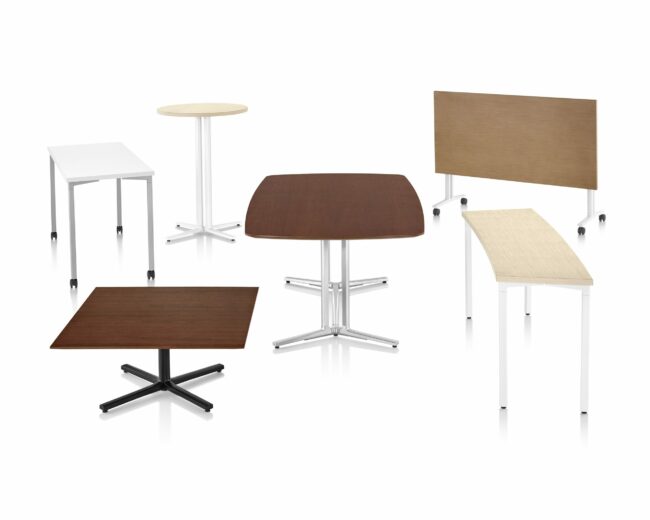
For example, when working on Herman Miller’s Everywhere table line, he focused on every detail, including a small part that isn’t visible unless the table is turned upside down. “In my opinion,” he says, “a Herman Miller product needs visual continuity in every detail, whether on the top, bottom, inside, or out.”
Grabowski takes special pride in this line because he feels it demonstrates everything he believes in as a designer. “The simplicity of the tables minimizes visual chaos in active spaces, bringing a sense of calm and order to the room. They are very simple forms, but they evoke an emotional response in people.”
A resident of Grand Rapids, USA, for much of his career, Grabowski also spent time as an instructor at Kendall College of Art and Design. His advice to students was, “Learn the basics; the fundamentals of design need to come first. At the same time, you need to understand technology so you can communicate your ideas electronically. That way, nothing will be misinterpreted or lost in the transition.”
See all