


Auctioneer Brent Lewis shares the incredible story behind a modern design treasure and its reunion with an iconic Craig Ellwood house
Original text by: Brent Lewis – Design Miami / Introduction: Amy Auscherman – Herman Miller / Photos: ©Marvin Rand; courtesy of Heritage Auctions
We have already shared a bit about the creation and design of the famous Coconut Chair, designed by George Nelson – which you can check out here.
Now, in the second part of this story, auctioneer Brent Lewis shares with us how an email led him to an incredible modern design treasure and a reunion with Craig Ellwood’s iconic house. Read the story:
In the summer of 2018, I received an email with a low-quality image of a Coconut Chair design, signed by George Nelson. I could not make out many details, except the chair’s potentially interesting color, a kind of orange-pink.
Perhaps my personal affinity for this design led me to respond immediately, inviting the client to consign it in my next Design auction while detailing estimates, terms, marketing, and logistics—a unique, all-inclusive proposal for something valued at around $2,000.
The reply days later was a single sentence: “Is this for the pair or just one chair?” I was confused and wondered if I had made a mistake. After reviewing the original inquiry, I saw that only one chair was shown.
Then I looked again at the reply and realized there was an attachment. It was a scan of a 1950s sales receipt listing “2 coconut chairs – $445.” The buyer named at the top was Craig Ellwood.

A bit about Craig Ellwood
Considered one of the leading advocates of mid-century modern architecture on the West Coast, Craig Ellwood was born Jon Nelson Burke in Texas in 1922. After the war, he moved to Los Angeles and founded Craig Ellwood Design in 1951 with his brother and a few contractor friends.
The 1950s were a great period for Ellwood, as he achieved both commercial and critical success. He regularly saw his work published in popular, design-focused media.
When finishing a house, he staged it—often borrowing furniture from Herman Miller—and sent the photos to dozens of stores around the world. The publications appeared in leading outlets across America.

Craig Ellwood’s Hunt House
The receipt they sent me had one more intriguing piece of information: the name and delivery address of Dr. Victor and Elizabeth Hunt, Malibu Road. Ellwood’s Hunt House, completed in 1957, is a notable example of mid-century modern architecture and certainly one of Ellwood’s most significant residential projects.
Composed of two boxes, one slightly lower than the other and connected by a central staircase, it sits atop the sand in Malibu, along one of Southern California’s most valuable beaches.
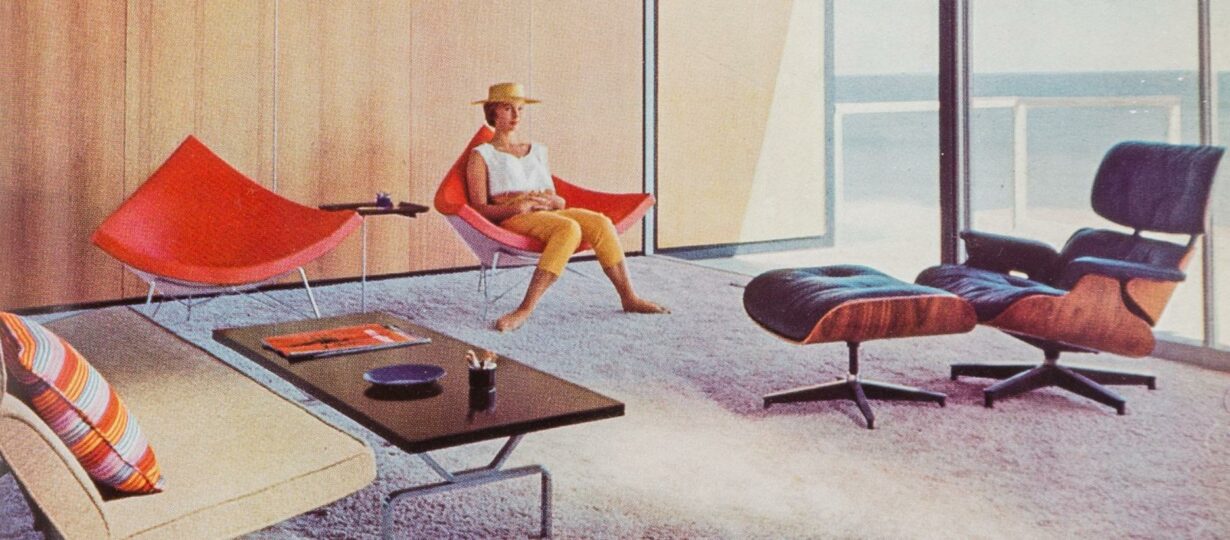
A quick Internet search will turn up a series of photographs by Marvin Rand, most of the same room—the lower, oceanfront box with glass walls overlooking the Pacific—which features a pair of Coconut Chairs in a color similar to the image sent to me in the original email.
Rand’s images are compelling. The Hunt House was published more than a dozen times in the few years after its completion, not only in Architectural Record, Architectural Design, Arts & Architecture, Kokusai-Kentiku, and DOMUS, but also in The New York Times Magazine, Holiday, and Sunset. In all, the same set of photographs is used, almost always focusing on the living room.
 Investigating the inquiry
There was a phone number to call. After speaking with the client by phone, I confirmed that these chairs were indeed from Ellwood’s Hunt House. I asked how he had acquired them, and he replied quickly, as if it should be obvious: “I used to own the house.” After a pause, he added: “I have everything.”
As the client explained, Elizabeth Hunt lived in the house after her husband died and until her own death, when my client became the caretaker. The house was then sold in 2012.
The buyer had ambitions to demolish the house and build something new in its place. Given his plan, he did not need the interior furnishings, so they ended up staying with the caretaker at his house in the valley.
I scheduled a visit with the client and found not only the Coconut Chairs, in a beautiful faded tone, but also the Sofa Compact, the Nelson Tables, the Eames Lounge and Ottoman, the Eames Wire Chairs, the original platform bed designed by Ellwood, the Nelson Dining Set, and much more, along with an archive of related documents that Elizabeth Hunt had faithfully kept.
 Also present was the coffee table that I initially could not identify in the original photos. The laminate was similar to that used by Eames for various Herman Miller designs, and the metal base structure was similar to the frame of the Sofa Compact, but I had never seen that table before.
In fact, few had. I called Daniel Ostroff, a historian and Eames design enthusiast, who said he had seen the design before, but only once. In the following months, as I discussed the table with him and others, I confirmed that only one other such table had ever been seen, which had also appeared in LA decades earlier. It was a little-known and quite rare table by Charles and Ray Eames, number 473-T.
Something became clear to me as I researched the furniture in this house and reflected on the remaining images: All the pieces were designed around the same time as the house. The Coconut Chair, 1955; the Eames Lounge and Ottoman, 1956; the Eames Sofa Compact, from the 1940s, but only in production in its current form since 1954.
 These designs were entirely new when the photos of the Hunt House were so widely circulated and so many people were seeing them for the first time. It is no wonder editors devoted so many pages to this new residence filled with cutting-edge contemporary design.
Meanwhile, the new owner, who did not appreciate the house, decided to sell it to the long-term tenants, architect Diane Bald and her husband Michael Budman, who fully understood its architectural significance.
They then hired Jahncke and his firm, Previous Partners, to oversee a total and complete rehabilitation of the house.
After sixty years near the ocean, much of the metalwork was in poor condition, and many of the surfaces had been bleached by the light spilling over the Pacific.
Could these historic works be restored? Was it worth the effort, especially considering that most of the designs could be acquired in new production?
But despite all their fragility, many examples can survive and exist with wear that can be appreciated, valued, and collected.
The Hunt House Coconut Chairs were certainly in that category, with a beautiful faded coloration in the upholstery and a striking, slightly aesthetic oxidation on the chrome frame. Beyond the effects of light and salty air, the furniture was well cared for.
Bald and Budman (the new owners) pursued the pieces that would be indispensable to the house and purchased many that can be seen in the documentation of the house’s restoration, such as the dining set, most of the living room table, the custom bed, and Elizabeth Hunt’s archive.
They, in turn, asked Lawrence Converso to help faithfully restore the furniture. After more than a year of diligent work, the restoration was completed, and the furniture was installed.
The restoration was recognized with the Los Angeles chapter of the American Institute of Architects’ Historic Preservation Honor Award.
Because of this strange confluence of events, these modern artifacts found their way home and now once again sit where they belong, on Malibu Road, as the ocean waves roll in day after day.
Incredible, isn’t it? Comment here with what you thought of this story, and stay tuned for more updates on the blog!