


An excerpt from a short story, born of chance, about the origins of design, starring a pair of vintage Coconut Chairs, with a special appearance by an influential California modernist.

Original text written by Brent Lewis – Design Miami / Presentation: Amy Auscherman – Herman Miller
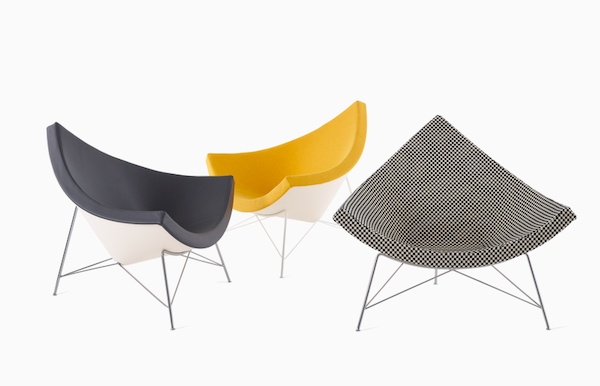
George Nelson’s Coconut Chair features a curious design, almost like the beginning of an origami fold. The story goes that Nelson—or perhaps George Mulhauser, who worked in Nelson’s office and designed the piece—related its shape to a piece of coconut.
The chair boasts generous proportions and is comfortable, yet it appears less frequently than other iconic mid-century designs. In fact, it is one of the few chair designs to emerge from Nelson’s office, as prolific as they were.
Design work on the Coconut Chair was completed in 1955 and it entered production at Herman Miller the following year. Besides being a breakthrough era for lounge seating, it must also have been an exciting year at the Herman Miller offices.
It was around the same time that they began production of the iconic 670/671 Lounge Chair and Ottoman by Charles and Ray Eames, not to mention the Nelson Marshmallow Sofa, which also made its debut in 1956.
 Herman Miller upholstery department, Zeeland, Michigan, 1956.
Quite a Duo
The Coconut Chair, which could also be accompanied by an ottoman, has been seen in many harmonious sets over the years. But it is a chair that does not carry the burden of being only one of a pair.
Seeing an Eames Lounge Chair without an ottoman, for example, seems almost abnormal, at once so vulnerable and naked. This is not the case with the Coconut, which stands proud and quite comfortable on its own.
It is also worth considering that, when it comes to chairs, few are as simple as the Coconut. It truly has the appearance of a fluid gesture, which, beyond the angularity of the seat edges and legs, gives the piece a very elegant overall look.
If you study its form as if it were a sculpture, you will see how it presents a balance. As you walk around the chair, it moves with you, always displaying its flexible curvilinear forms, while blending organic quality with geometric rigor. It is truly a perfect chair.
 A pair of Nelson Coconut Lounge Chairs from Craig Ellwood’s Hunt House. Photo © Heritage Auctions.
A Rare Piece
Created in the mid-1950s, there are many things experts can do to assess the authenticity and date of something that has been in production for many decades.
The provenance itself and the personal stories of the owners or families are interesting and always significant for providing context and color. And, of course, there is the object itself, with labels, markings, construction methods, and patina. But nothing replaces pure documentation.
In this case, an email would lead us to an even more interesting story. In the message, there was an attachment. It was a scan of a sales receipt from the 1950s, which listed “2 Coconut chairs – $445”.
The buyer mentioned at the top was Craig Ellwood, one of the greatest proponents of mid-century contemporary architecture on the West Coast of the United States.
Thus, the product invoice would lead us back to one of the modern homes of a great contemporary architect. This would also culminate in a new sense of discovery when images of the chairs in their original home were found—the icing on the cake.

Herman Miller promotional photograph, 1956.
Curious to know the outcome of this story? Then don’t miss the second part of this series, in which auctioneer Brent Lewis tells how he discovered the existence of a valuable set of original furniture from the home of renowned modernist architect Craig Ellwood. Stay tuned!